What should I ask before arranging a home survey?
Buying a home with a mortgage? Before booking a survey, clarify what is included, when you will receive the report and how you will follow up questions. Use this checklist alongside your mortgage preparation.
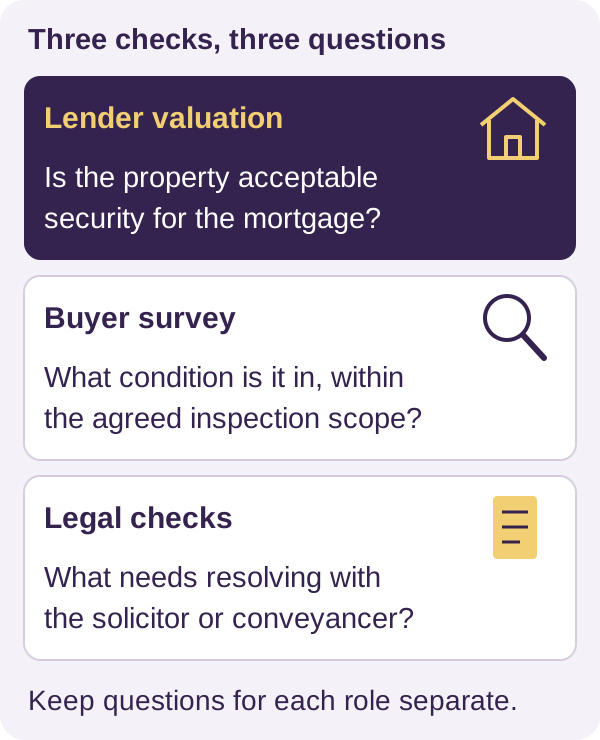
Which checks are being arranged?
A mortgage valuation, a home survey and legal checks have different jobs. GOV.UK explains the separate stages: the lender values the property for the mortgage, a survey examines its condition, and your solicitor or conveyancer handles legal work and searches.
The diagram separates those three conversations. Write down who is arranging each check and which questions you still need answered. A lender accepting a property does not replace your own investigation of its condition.
This checklist focuses on buying in England and Wales. If you are buying elsewhere in the UK, ask your conveyancer about the local process before using it as a timetable.
What should I tell a surveyor before booking?
Keep the property details and your concerns together: its address, approximate age if known, construction or alterations you have been told about, and anything you noticed at a viewing. Mark uncertain information as a question rather than a confirmed fact.
MoneyHelper explains the different survey levels. The property's age and condition matter when choosing a service; price alone is not enough. Ask a suitably qualified surveyor:
- Which level of survey do you recommend for this property, and why?
- What will you inspect, and what will be outside the agreed scope?
- Does the report include a valuation or advice about repairs?
- Do you have experience of this type of property?
For example, if an extension is mentioned in the sales details, note it for the surveyor and separately ask your conveyancer about the relevant paperwork. Do not assume either conversation answers the other.
What should I check in the quote and timing?
Use a short booking record for each quote. These are prompts for your own notes, not a required lender form:
- Service: provider, survey level, scope and exclusions.
- Cost: total quoted fee, what it includes, when payment is due and any cancellation terms.
- Timing: proposed visit, expected report date and who will arrange access.
- Follow-up: whether you can discuss the report and how any additional investigations would be arranged and priced.
Keep valuation and survey costs as separate entries until you know what is included. If a lender offers a valuation without a charge, do not assume that includes a buyer's condition survey. Ask the lender to confirm its service and any fee.
Keep these costs outside the deposit you enter into our deposit calculator. Use the illustration alongside your own purchase-cost budget, not as confirmation that all costs are covered.
What should I do when the report arrives?
GOV.UK's survey guidance recommends reading the report carefully and discussing findings with the surveyor. Further specialist investigation may be needed.
For each unresolved issue, record the report reference, the question, who will answer it and the next step. For example: “The report recommends another inspection. Who should carry it out, what will it cost, and when can we discuss the result?”
Take condition questions to the surveyor, legal questions to your conveyancer and mortgage implications to your lender or advisor. Ask your conveyancer to confirm readiness before exchange; receiving a report is not the same as resolving its findings.
For the wider process, return to our buying-a-home guidance or first-time buyer guide. To discuss your mortgage plans, use the first-time buyer callback form. It explains referral to MGI Network Ltd, the advice partner; a callback does not book a survey. Keep reports and financial documents out of the optional notes.
Sources
- GOV.UK: making an offer — legal checks, valuation and surveys.
- MoneyHelper: buying and moving costs — survey scope, levels and separate costs.
- GOV.UK: how to buy a home — choosing a surveyor, following up findings and preparing for exchange.
Information checked 26 October 2026. General information, not a personal mortgage recommendation.
Discuss your circumstances